

Dimensional Weight: Why Your Shipping Bill Is Higher Than It Should Be
You weighed the package at 8 ounces, but your carrier charged you for 3 pounds. Here's how dimensional weight pricing works, how to calculate it, and five ways to lower it.

You weighed the package. It came in at 8 ounces. And somehow your carrier charged you for 3 pounds. Welcome to dimensional weight — the pricing method that trips up more eCommerce sellers than almost anything else in shipping.
Once you understand how it works, you can do something about it. Here's the full breakdown.
What Is Dimensional Weight?
Dimensional weight (also called DIM weight or volumetric weight) is a pricing method used by UPS, FedEx, and USPS that charges you based on the space your package takes up — not just what it weighs on a scale. Carriers use it because a truck can run out of room long before it runs out of weight capacity. A box of pillows takes up serious real estate, even if it barely registers on a scale.
The rule is simple: you pay whichever is higher — actual weight or dimensional weight. So if your package weighs 6 oz but has a DIM weight of 2 lbs, you're billed at 2 lbs.
How to Calculate Dimensional Weight
The formula is: Length × Width × Height ÷ DIM divisor = DIM weight (in pounds).
As of 2026, the standard DIM divisors are:
- UPS and FedEx: 139 (for most shipments)
- USPS Priority Mail: 166
- DHL Express: 139
Quick example: a 12" × 10" × 8" box with a 1-pound product inside. The math is 12 × 10 × 8 = 960 cubic inches, divided by 139 = 6.9 lbs — rounded up to 7 lbs. So you're paying for 7 pounds on a package that weighs 1 pound. That's not a typo.
USPS's higher divisor (166) often makes it the cheaper option for lighter, bulkier shipments. A 15-20% reduction in billable weight per package adds up fast when you're shipping hundreds of orders a month.
When Dimensional Weight Kicks In
FedEx and UPS apply DIM weight pricing to every package, regardless of size. USPS only applies it to packages larger than 1 cubic foot (1,728 cubic inches) for Priority Mail and Parcel Select. For smaller items, USPS charges based on actual weight alone — which is one reason USPS can be the better value for small, lightweight packages.
The Real Cost of Oversized Boxes
Most packaging damage happens because sellers use boxes that are too large and try to compensate with extra void fill. But oversized boxes don't just waste materials — they inflate your DIM weight and drive up every single shipping charge.
Consider a seller shipping 500 orders a month in boxes that are one size too large. If DIM weight inflates each billable weight by even 1 lb, and the per-pound rate is $1.50, that's $750/month in unnecessary shipping costs — $9,000 a year.
Five Ways to Lower Your Dimensional Weight
- Right-size your boxes. Use the smallest box that fits your product with adequate cushioning. This is the single biggest lever.
- Switch to mailers for soft goods. A poly mailer weighs almost nothing and has near-zero DIM weight for most carrier calculations on lighter shipments.
- Standardize on 3-4 box sizes. Every extra size is another decision point. Fewer sizes, better optimization.
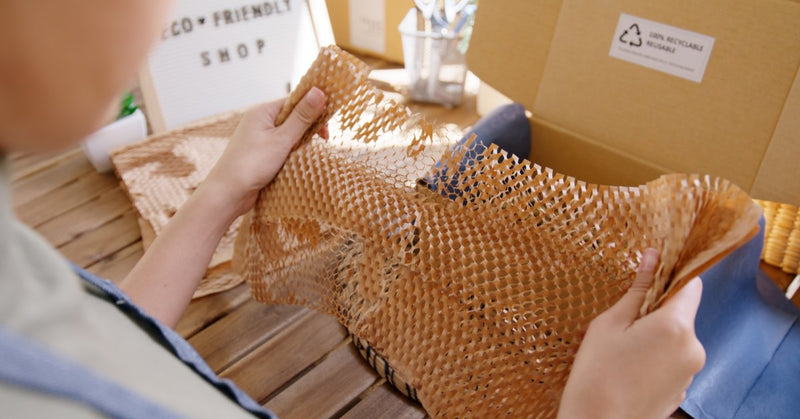
- Compress your cushioning. High-density foam and properly sized honeycomb paper add less volume than loose bubble fill.
- Consider USPS for light, small packages. The 166 DIM divisor frequently results in lower DIM charges than FedEx or UPS at 139.
What to Do Right Now
Pull your top 10 SKUs and calculate the DIM weight for each using the current box you're shipping them in. Compare it to the actual weight. If DIM weight is higher on more than half of them, your boxes are too big.
The Bottom Line
Dimensional weight is not a hidden fee or carrier gimmick — it's a reflection of the physical space your package occupies. Understanding it is the first step to making packaging decisions that keep your shipping costs under control.
The quickest fix is often the simplest one: a smaller box or the right mailer. Check out Wrapama's full range of corrugated boxes and poly mailers — sized for real eCommerce products, not packing air.
Tips, guides, and subscriber-only deals. One email at a time.


Join our newsletter now!
Register now and get our latest updates and promos.
